
“Our biggest concern right now is how do we design a space that’s different than what we had before?” said Jorge Perez, the president and CEO of the YMCA of Greater Cincinnati. “Because we just keep trying to improve what we had before. What about redesigning the whole space all together? I think we’re going to be challenged to get out of our very well-established ruts if our intent is to help people connect with each other.”
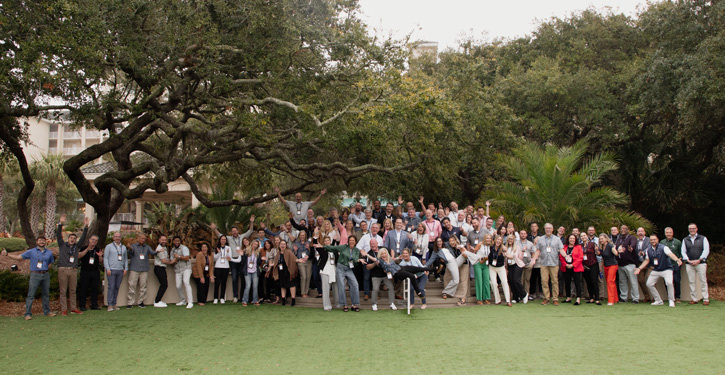
Perez said those words as he moderated a roundtable on attracting and retaining future members at the 2026 Community Rec Leadership Summit at the Omni Amelia Island Resort in Fernandina Beach, Florida.
His thoughts echo the overall theme of this year’s Summit — while the industry has endured challenges and valleys in its evolution, plenty of opportunities exist for nonprofit rec center leaders to create new successes and peaks in their communities.
For three days, leaders from YMCAs, JCCs, Salvation Army, and more — alongside limited sponsors — convened on the topics of growth strategies and expansion, capital campaigns and financing; innovative programming and trends; attracting and retaining future members; AI and tech integration for impact; and developing the next generation of leaders.
Here are some of the biggest takeaways from each roundtable at this year’s Community Rec Leadership Summit:
Growth Strategies and Expansion, Capital Campaigns and Financing
- Kevin Bolding, the president and CEO of the YMCA of Central Florida, said his YMCA is really leaning into partnerships with healthcare entities. These organizations have a lot of money and resources, and strategic, prevention-focused conversations unlock different funding buckets than traditional sponsorships.
- Move beyond traditional sponsorship asks. Simply asking, “Can you sponsor this program/sport?” leaves millions of dollars on the table. Funders respond to clear value propositions and evidence.
- Utilize sophisticated capital and feasibility planning. Use market studies to understand primary markets. This helps stack projects in a logical order and ensures capital plans reflect community identity and needs.
- Potential partners go beyond healthcare. Libraries and churches are rethinking how they engage communities and create experiential spaces. Co-creating shared spaces with these institutions can expand reach, reduce facility costs and deepen community presence.
- Center leaders need to be actively out in the community and understanding how others are evolving. If leaders are not present, the team risks hearing about opportunities after decisions are made.
Innovative Programming and Trends
- Boyd Williams, the president and CEO of the YMCA of the Pikes Peak Region, said his YMCA brought physical therapy in-house, choosing not to renew their outside vendor and instead hiring salaried personal trainers. This move is a distinctive, revenue‑generating differentiator, since few Ys are providing personal trainers fully in-house.
- Turnaround strategies for non-profitable childcare programs include implementing the USDA Food Program to offset meal costs, adding fee-based programs and leverage pre-K public funding.
- The YMCA of Greater San Antonio has entered its second full year of offering mental health and counseling services. Sustainability of the program is explicitly built around filing for and obtaining Medicaid billing status. They now have 10 licensed counselors, including three bilingual counselors offering services in Spanish, which increases both access and reach.
- Maximize underused space with high-impact, inclusive programs. This can include adults with special needs and after-school literacy initiatives.
- Rethink operating models. Frame not as “we need a new gym,” but “we need new types of spaces and programs to meet emerging, high-priority community needs.”

Attracting and Retaining Future Members
- Relationships are the core retention strategy. The click-to-cancel law and similar policies only hurt if relationships and belonging are weak. When people feel connected and see value, easy cancellation isn’t a threat.
- Online cancellations have replaced many exit interviews. Reported reasons often mask deeper issues like unmet goals or weak connection. There’s a need for new methods to understand real cancellation drivers.
- Timothy Burrows, the VP of healthy living and operations at the YMCA of Florida’s First Coast, said his team is focusing on healthy aging with seniors. They hired part-time leaders for this group to run low-cost relational activities that significantly deepen belonging and increase visits.
- Current enrollment and financial-verification practices can contradict the stated values of welcome and belonging. Policies are often built around the small minority who might abuse the system, rather than the majority who genuinely need support. A more trust-based, lower-friction approach to joining and financial assistance better aligns with mission and supports long-term retention.
- If transformational language is used but decisions are driven only by transactional/financial logic, the transformational mission “dies.” Authentic care and relationship-building must remain central, even as financial realities are managed.
AI and Tech Integration for Impact
- Noted concern about AI’s role in shaping adolescents’ relationships and its connection to youth and teen suicide. There’s a need for youth-focused awareness programs in childcare and youth programs about safe AI use.
- Staff may feel shame or fear that using AI means they’re less competent or less professional. Leaders should explicitly encourage transparent AI use so people can learn from each other. AI use should be seen as a professional skill, not “cheating.”
- Leaders must educate themselves about AI so they can meaningfully evaluate how others use it. They also must create safe cultures where experimenting with AI is encouraged and discussed openly. Champion guidelines and training that emphasize ethics, mental health and long-term impact, not just efficiency.
- Perez said we should acknowledge that AI uses significant electricity and physical resources, pressuring local power grids. Social service and community organizations should participate in
- accountability conversations about AI’s environmental footprint.

Developing the Next Generation of Leaders
- Sydney Lia, a branch executive at Foothills Area YMCA, said career paths can be built through opportunities, not just positions. Giving emerging leaders a seat at the table, stretch projects and strategic assignments can provide growth even when no higher title is open.
- Younger staff seek coaching differently — via phones and AI. Emerging leaders are more likely to consult Google/AI than call a mentor, so organizations should meet them where they are with safe, values-aligned tools.
- Flexibility is now a core leadership strategy, not a perk. To attract and retain leaders, organizations must consider remote work, flexible schedules and other adaptations that align with desired culture.
- High retention creates advancement bottlenecks. Strong retention limits available roles, especially at higher levels, so organizations must name this reality and manage it deliberately.
- Success includes preparing people to leave well. Developing leaders so they can move to higher roles elsewhere is framed as a win, demonstrating the strength of internal development.
The Summit is Back in 2027
If you’re interested in participating in the Summit, then mark your calendar. The 2027 Community Rec Leadership Summit will be held at the Omni Rancho Las Palmas Resort & Spa, a luxury, four-star resort in Palm Springs, California, from February 22-24. New attendee and sponsor spots are now open. Email editor John Reecer at john@peakemedia.com to learn how you can join us. Hope to see you there!