
How YMCA of Central Ohio partnered with NinjaZone to reach a hard-to-engage age group, create new member value and build a sustainable program.
For many community rec organizations, finding new ways to engage families often comes down to more than introducing another program. Leaders also have to consider available space, staffing, member demand, operational capacity and whether a new offering can be sustained over time.
At the YMCA of Central Ohio, the opportunity to address several of those considerations came through NinjaZone, a youth programming provider blending gymnastics, parkour, martial arts and obstacle course training.
The partnership — which officially launched five months ago — began with a relatively straightforward goal: create a new experience for children who were aging out of traditional Kids Zone offerings but weren’t necessarily ready for or interested in other organized activities.
Lolita Haverlock, the senior vice president of operations at the YMCA of Central Ohio, said that age group represented an important opportunity.
“One of the biggest opportunities we saw with NinjaZone was the ability to better serve an age group that can sometimes be challenging to engage,” said Haverlock. “These are kids who are beginning to outgrow traditional kids zone offerings but are still young enough to benefit from structured, age-appropriate activities. NinjaZone gave us an opportunity to create something fresh and exciting specifically for them.”
The program also aligned with the YMCA of Central Ohio’s broader focus on families with children ages 3-12, while creating another avenue for kids to stay active and connected to the Y.
Starting With the Space They Had
The partnership took shape through a process focused less on bringing in a predetermined program and more on understanding what Central Ohio already had available.
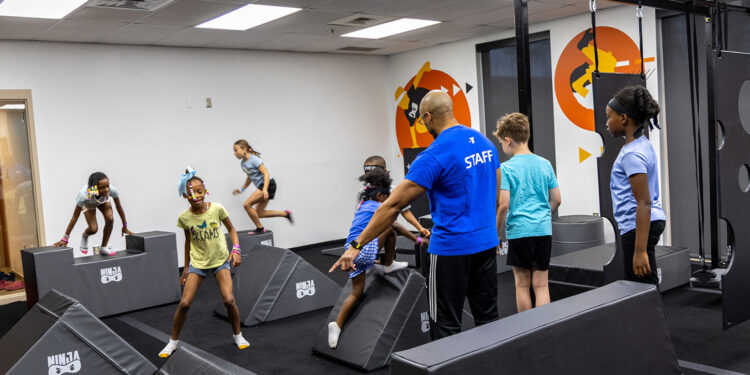
Erica Barnes, the director of partnerships at NinjaZone, first met representatives from the YMCA of Central Ohio at a conference before traveling to Columbus to tour the facilities and meet with Haverlock and the team. During that visit, the organizations identified two former physical therapy rooms that were largely unused.
Rather than treating the available footprint as a limitation, the teams began considering how it could be repurposed.
“What’s funny is we went in thinking NinjaZone was going into one space, but as we walked the facility together, we started seeing completely different possibilities,” said Barnes. “They had two former physical therapy rooms that really weren’t being used at all, and we were able to stand there together and visualize what those spaces could become.”
Today, one room is dedicated to preschool-age programming and the other to school-age children.
For the YMCA of Central Ohio, that represents an operational benefit beyond simply adding another class to its schedule. The organization was able to put previously underutilized space to work while creating an offering that could serve both existing members and prospective families.
“From an operational standpoint, the program has helped us make better use of previously underutilized space while creating new sources of revenue,” said Haverlock. “In addition to ongoing program participation, it opens the door to opportunities such as birthday parties and other special events.”
The approach also illustrates a broader consideration for community recreation leaders: Before looking for additional square footage, organizations may be able to identify new opportunities within spaces that are already part of their facilities.
Building a Program Around Staff and Systems
Space was only one part of the equation. For the YMCA, the program also needed to be approachable for staff and sustainable beyond the initial launch. That’s where NinjaZone’s broader support model became important.
Barnes said the company works with recreation organizations on more than curriculum, providing assistance with areas including space design, equipment, class structure, pricing, staffing, marketing, launch strategy and ongoing coach education.
“We like to say that we become a virtual program director for NinjaZone,” said Barnes. “Yes, we provide the curriculum, lesson plans and coach training, but that’s really just the beginning.”
This type of structure can help community rec departments that are managing part-time staff reduce the amount of program development required from individual instructors. At the YMCA of Central Ohio, Haverlock said the weekly curriculum gives instructors a framework while allowing them to focus on interacting with participants.
“That’s especially valuable when working with part-time staff,” said Haverlock. “Rather than asking instructors to spend significant time developing lesson plans, the curriculum allows them to focus their energy where it matters most, connecting with the kids, creating a positive experience, and making every class fun and engaging.”
That also addresses a common operational challenge: building programs that aren’t dependent on one individual employee.
“Programs don’t always struggle because they’re bad programs,” said Barnes. “Sometimes they don’t get off the ground correctly. Sometimes they aren’t promoted in the community correctly. And sometimes one great staff member ends up carrying the whole thing. Our job is to put systems around the program so it can grow and continue regardless of who is coaching it.”
For the YMCA of Central Ohio, the combination of curriculum and ongoing support has helped make the program more accessible to instructors while giving leadership a framework for continued growth.
Creating More Value for Families
The operational considerations ultimately connect back to the member experience.
NinjaZone gives the YMCA another option for children who may not gravitate toward traditional team sports while still incorporating physical activity, skill development and confidence-building.
Haverlock said the program can help children develop body awareness, coordination, and comfort with physical activity while introducing principles such as perseverance, discipline, sportsmanship and encouraging others.
“It can also serve as a great foundation for whatever comes next,” said Haverlock. “As children grow and discover the sports or activities they’re most passionate about, they’ve already developed greater body awareness, coordination, confidence and a comfort with being physically active.”
The program has also created an early example of how programming can support membership growth. Haverlock said one participant became a Y member after attending just one NinjaZone session.
That result is particularly relevant for community recreation organizations competing for families’ time and dollars. A new program doesn’t necessarily have to replace existing offerings to provide value; it can create another reason for families to engage with an organization.
“For families, NinjaZone provides another reason to engage with the Y,” said Haverlock. “We’ve already seen that engagement translate into membership, including a participant who became a Y member after just one NinjaZone session.”
Barnes said that combination of member engagement, operational efficiency and program sustainability is the larger opportunity.
“Families have a lot of choices now,” said Barnes. “They’re looking for programming that kids are genuinely excited about, but parents still want structure, progression and a reason to keep coming back.”
The partnership also demonstrates the importance of continued support after a program launches. Haverlock said the Y has been impressed by the responsiveness of the NinjaZone team and the resources available to instructors and staff.
“One of the biggest pleasant surprises has been the level of support that comes with the program,” said Haverlock. “Tyler and the NinjaZone team have been incredibly responsive and willing to help, whether we have a quick question or need advice on a larger aspect of operating the program. It really feels like there’s a team behind you that wants to see the program succeed.”
For community rec leaders evaluating new youth programming, the YMCA of Central Ohio’s experience offers a practical takeaway: A successful program can require more than a compelling activity.
Assessing existing space, creating repeatable staff systems, understanding the target audience and planning for continued support can all influence whether a new offering becomes a sustainable part of the organization.
NinjaZone has provided a way for the YMCA of Central Ohio to bring those pieces together — transforming previously unused rooms into active programming spaces while giving families another reason to see the Y as a place where their children can explore, grow and stay connected.