
This installment of Community Voices brings together a panel of industry leaders to explore how nonprofit community rec center leaders can best capitalize on the strength training boom.
This discussion provides insights into evolving member demographics, equipment and space considerations, programming opportunities, and ways to make strength training approachable for beginners and older adults. Experts can also learn practical strategies for balancing strength with traditional cardio offerings, maximizing existing spaces and creating inclusive environments. Leaders will be able to determine where to invest resources while ensuring strength offerings support broader goals around health, engagement and retention.
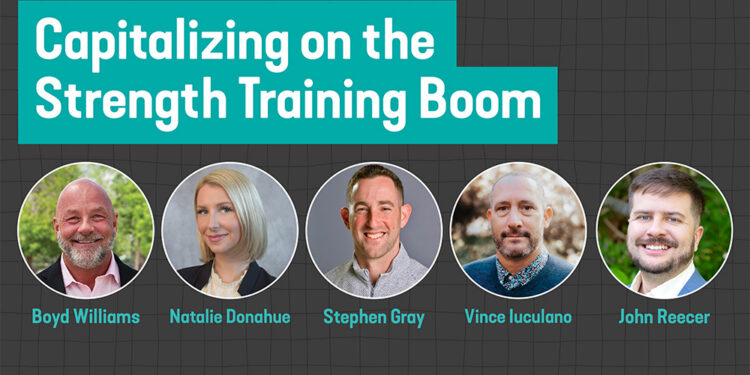
The panel included:
– Boyd Williams, the president and CEO of the YMCA of the Pikes Peak Region
– Natalie Donahue, the regional executive director of the Tri-County YMCA of New York
– Stephen Gray, the senior director, JCC Health & Wellness at Prosserman JCC
– Vincent Iuculano, the CEO of the YMCA of the Foothills
What the Panelists Are Seeing
All four panelists said the strength training boom is real, reaches many kinds of members and isn’t going away. Williams opened with national data. Free weights have been the fastest-growing segment since 2021, with more than 26 million U.S. users. Gen Z makes up the largest share, at over 36%. He noted low-cost, high-volume clubs are going hard after that group. In his market, personal training among women grew 16% over last year. Thirty years ago, women rarely came into weight rooms. Now his Y has cut back cardio and redesigned its centers to welcome everyone.
Donahue spoke from her own experience. After having a child, working with a trainer this year made her stronger than ever. She sees more women getting comfortable with weights. Her Y’s personal training director specializes in prenatal and postpartum training, and young women and seniors now train side by side.
Gray said the Toronto JCC flipped the floor plans at both campuses, shrinking cardio and adding strength space. Gen Z floods in after school, and that’s a chance to build the future audience, but it also strains evening capacity. In his words, “the fitness center is the new mall.”
“Since COVID-19, the boom is maybe like five years in at minimum,” said Gray. “We’re almost seeing the boom of the boom, or the ripple effect now. Five to seven years later, and it’s not even about catching up to it. It’s recognizing that it’s probably here to stay.”
Iuculano said his Y’s heavy lifting program is at 100% occupancy, and 90% of participants are women. He also said social media and influencers drive Gen Z’s interest. His team teaches trainers about those trends so they can turn them into safe, practical advice for members.
Helping Members Belong
The panel agreed that making the weight room less intimidating takes deliberate onboarding, welcoming staff and a well-designed space, not just good equipment.
Donahue said it starts with making people feel welcome. New members at her Y get an orientation to learn the equipment and meet the floor staff. Her health and wellness director learns members’ goals, checks in regularly and makes sure they always know someone is there to help.
Gray named three priorities:
- Fit Start consultations. Every new member and every member once a year is actively invited to a goal-setting conversation. A floor orientation follows, which also works as a personal training sales tool.
- Open functional space. He called it “a gym operator’s best friend,” as opposed to filling every inch with machines.
- Trainers as ambassadors. Personal trainers build relationships with all members, not just their clients, so there’s no tier system.
Williams replaced his wellness attendants with certified personal trainers. They run “jump start” sessions, and the Y tracks those against monthly targets. He wants education to be easy to get and spaces to include women, older adults, teens, beginners and people with disabilities. He also redefined success: not bench press numbers, but an 80-year-old staying independent or a teenager gaining confidence.
“The weight room should not feel like it only belongs to the strongest or most experienced person in the building,” said Williams. “It needs to belong to everyone.”
Strongest Strength Training Programs
The common thread was structured programs, coaching and community get better results than open equipment alone.
Gray pointed to group exercise. His two campuses run 130–140 Group X classes a week, and members and instructors made it clear that strength options had to be part of the lineup. Strength-focused classes, such as functional strength and Pilates, draw bigger crowds. That pushed the JCCs to add sessions in the early morning, after work and in the evening.
Iuculano credited structured programs like Les Mills formats like body pump, one-on-one and small group personal training. His heavy lifting Group X class, where 90% of participants are women, is still a major driver.
Williams said participation grows when strength training comes with coaching, community and confidence. He uses small group training as the bridge between Group X and personal training. Every new member gets an Evolt body composition scan, and staff are held to accountability targets.
“It’s very intimidating to walk into a weight room or a gym when you don’t know what half the equipment does, and I think what it comes down to is being intentional and making people feel welcome when they do get to your Y or your health center,” said Donahue. “Like a lot of other YMCA’s or health centers, we start our members with an orientation, which kind of gives them a chance to learn the equipment and get comfortable with the space.”
Dealing With Limited Footage
The panel agreed that centers short on space should rethink and reassign the space they have before adding square footage.
Iuculano said exercise variety per square foot matters, but the environment comes first. He checks every space for natural light, organization, music, well-maintained equipment and an effective welcoming staff.
Gray said members keep asking where they can stretch, recover or work on mobility. Large turf strips at both campuses take up a lot of room but get far more use. He urged operators not to fear shrinking cardio. Cutting it at both campuses increased activity and member satisfaction.
Donahue runs a small Y where pivoting is their forte. She turned an underused stretch studio into a small group training room with a rack, functional trainer and dumbbells without adding any space. Her test is to ask whether each room still serves members in the best way possible.
Limited Budget Answers
On a tight budget, the panel favored versatile basics, buying only once there’s evidence of demand, and investing in people.
Donahue said your first dollars should go to dumbbells, kettlebells, resistance bands and adjustable benches, which serve the widest range of members. She and her personal training director work out how many training packages they’d need to sell to earn back a purchase. That tells them whether to buy now or wait.
Gray said dumbells are versatile, easy to move around and almost never need maintenance. His bigger lesson was to wait for proof that something will get used. He treats his personal trainers as his “eyes and ears.” After a year of watching lines form at a rear delt machine, he bought a second one.
“A modest equipment package coupled with good trainers and good Y leaders, add in a little thoughtful programming, and that goes a really long way,” said Iuculano. “We’ve seen it go from concept to actual practice every day at our YMCA’s.”
Final Advice
The final advice came down to one message: remove barriers, invest in people, and focus on results and community rather than flashy equipment.
Iuculano said people intimidated by weight rooms aren’t a small minority — they may be most of the membership. He urged leaders to check their facilities: are they welcoming, well lit, organized, clean and easy to get around? Then add great trainers and floor staff who engage people.
Gray told operators to drop the pressure to own the biggest, most expensive equipment. Keeping members, though, depends on two things: getting them results and building connection. If you manage both without giving up either, the rest follows.
Donahues’s top advice was to invest in staff. Frontline trainers and wellness staff hear what members want every day, so listen when they ask for training or certifications. Build both their technical knowledge and their leadership and people skills, because relationships are what keep members coming back.
Williams closed by describing the strength training boom as a basic change in how people think about health.
“With how technology has changed, I think people’s education and understanding of health and fitness and health and wellness has also evolved,” said Williams. “People are now increasingly understanding words like longevity, mobility and bone health. So, we must stay current and educated and understand what our members need. We must lower the barriers to entry. We have an extraordinary opportunity that we don’t have to be the biggest or flashiest weight room in in the community, but we need to become the place where a greater number of people believe that strength training is for me.”
Watch the full on-demand conversation below after registering for free!