Recreation centers are working to serve every member of their communities. As a result, adaptive fitness and inclusive accessibility are moving from specialty offerings to core expectations.
Industry leaders are finding that removing barriers — whether physical, sensory or social — does more than meet an individual need. It builds trust with families, draws new participants through the door and strengthens a facility’s role as a place where everyone belongs.
Approaches vary as some organizations build programs designed specifically for children and young adults with disabilities. Others invest in technology and design that let visitors navigate and use a building independently. Both paths aim for the same outcome: people of all abilities feel welcome and are able to participate.
Below, discover how the Bloomsburg Area YMCA in Bloomsburg, Pennsylvania, and Bender JCC of Greater Washington in Rockville, Maryland, are expanding access through adaptive fitness and inclusive accessibility.
Bloomsburg Area YMCA
The Bloomsburg Area YMCA developed its “I Can Y” initiative, an umbrella for programs designed to remove barriers for individuals with disabilities and their families. The initiative includes:
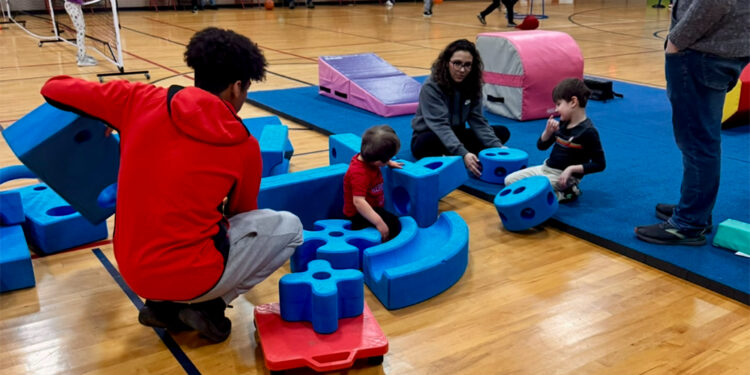
Adaptive Recreation. Introduces children to traditional and non-traditional sports, obstacle courses, sensory activities, and other forms of movement with an emphasis on participation, confidence and social connection rather than mastering a sport.
Adaptive Fitness. Gives young adults with disabilities an exercise-focused next step, helping them become comfortable exercising, learn appropriate fitness activities and develop healthy habits in a supportive setting.
Additional Offerings. I Can Work, I Am Safe, Sensory Santa and other sensory-friendly opportunities.
Wayne Stump, the CEO of the Bloomsburg Area YMCA, said the work begins with a simple belief.
“Everyone should have the opportunity to be active, try new things, build relationships and feel like they belong at the Y,” said Stump.
Since launching, Adaptive Recreation has offered multiple 12-week sessions along with summer programming, serving more than 125 children. Sessions average approximately 22 participants with around 90% attendance.
“To me, one of the strongest indicators that you’re meeting a need isn’t simply how many people register. It’s whether they keep coming back,” said Stump.
The Y has also taken its programming beyond its own walls. Adaptive Recreation now runs weekly at an elementary school in the Y’s service area, and other school districts bring their special needs classes to the YMCA for Adaptive Field Trips.
“We’ve also learned that accessibility sometimes means taking the Y to people rather than expecting everyone to come to us,” said Stump.
Stump said families continue to register, participants keep showing up, and parents tell other families and professionals about the program. For example, he said one couple shared the program with their child’s physical therapist, who has since volunteered and shared the opportunity with other patients and families.
“That type of organic connection is incredibly meaningful because it tells us families see enough value in the program that they want the other people supporting their child to experience it and help others discover it as well,” said Stump.
Geisinger Health System — a regional healthcare system — has been instrumental in developing and sustaining the work. Through that partnership, the Y is now scaling Adaptive Recreation for two additional YMCAs in its region, developing the program structure, training support, implementation resources and data requirements those branches can use.
The Y is also working with a national company on adaptive-appropriate, sensory-aware equipment designed with children and programs like its own in mind.
“Our goal isn’t to tell another YMCA, ‘Here’s exactly how you have to do it,'” said Stump. “It’s to say, ‘Here’s what we’ve learned, here’s a framework and resources to help you get started and now let’s make it work for your community.'”
Bender JCC of Greater Washington
Bender JCC of Greater Washington recently implemented RightHear, technology designed to give people who are blind or have low vision greater independence when navigating the facility. The system includes:
Free Smartphone App. Visitors use the app to access information as they move through the building.
Camera-Readable Markers. Markers placed throughout the Bender JCC work with the app to identify a visitor’s location.
Spoken Information. Visitors receive audio details about where they are, what is around them and nearby destinations.
Mauricio Garcia, the chief marketing officer at the Bender JCC of Greater Washington, said the technology addresses a challenge that is easy to overlook in a multi-use community center.
“Someone may be coming to use our fitness center, pools, gymnasium, theater or another program space,” said Garcia. “Being able to independently identify and navigate to those destinations removes a barrier that those with full vision may never have to consider.”
Because the implementation is still new, the JCC is focused on building awareness and adoption. Staff have begun working internally across the organization so members who may benefit know RightHear is available.
The JCC is also reaching out to organizations serving people who are blind or have low vision throughout the region. As more people use the technology, the JCC hopes their feedback will help it continue improving the experience.
The response so far has been positive, and Garcia said the JCC is being candid about what it does not yet know. It does not have enough direct feedback from blind and low-vision users to make claims about long-term impact, and it is actively working to change that.
“Members appreciate seeing us continue to invest in accessibility and look for ways to make the Bender JCC a place where more people can participate independently and feel a genuine sense of belonging,” said Garcia.
RightHear builds on years of work in universal design that extends to both programming and the physical environment. The JCC has invested in accessible equipment that allows people with different mobility needs, including individuals who use wheelchairs, to participate more fully in exercise and wellness activities.
“Our goal isn’t simply to create separate opportunities for people with disabilities,” said Garcia. “Wherever possible, we want to remove barriers so people of different abilities can participate in the same programs, spaces and community experiences.”

Final Advice
Stump’s top advice for industry leaders is to start before everything is figured out. Specialized equipment, additional space, more staff or a large budget can help, but they shouldn’t become reasons to wait.
“Start by listening,” said Stump. “Talk to individuals with disabilities, parents, caregivers, schools and organizations already serving this population. Don’t assume you know what people need.”
He also encouraged leaders to find partners who share their vision, and to measure impact from the beginning. That means tracking participation and attendance as well as confidence, physical activity, social connection and family feedback. Finally, adaptive programming shouldn’t be treated as an add-on.
“We started by asking how we could create a recreation opportunity for children with disabilities,” said Stump. “What we’ve learned is that the bigger opportunity is creating a culture of belonging.”
Garcia’s advice centers on treating accessibility as an ongoing commitment rather than a finite project.
“Accessibility shouldn’t be viewed as a checklist or a one-time project,” said Garcia. “As we often say at the Bender JCC, the work of inclusion is never done.”
He urged leaders to think beyond physical access and ask whether visitors can navigate a building independently, use the equipment and participate in programs. Garcia said the highest level of inclusion is social inclusion, and that physical accessibility helps make it possible.
“Listen to the people you serve, involve individuals with disabilities in those conversations, and look at accessibility across the entire experience,” said Garcia. “You don’t have to solve every challenge at once.”