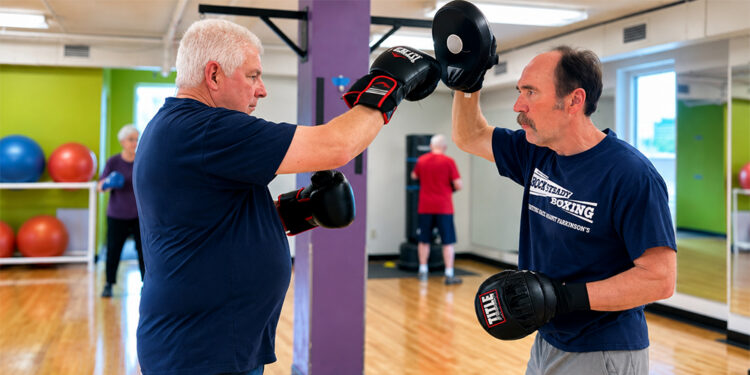
The YMCA of South Hampton Roads is helping community members with Parkinson’s fight back against the disease by offering Rock Steady Boxing classes at two of the Y’s branches.
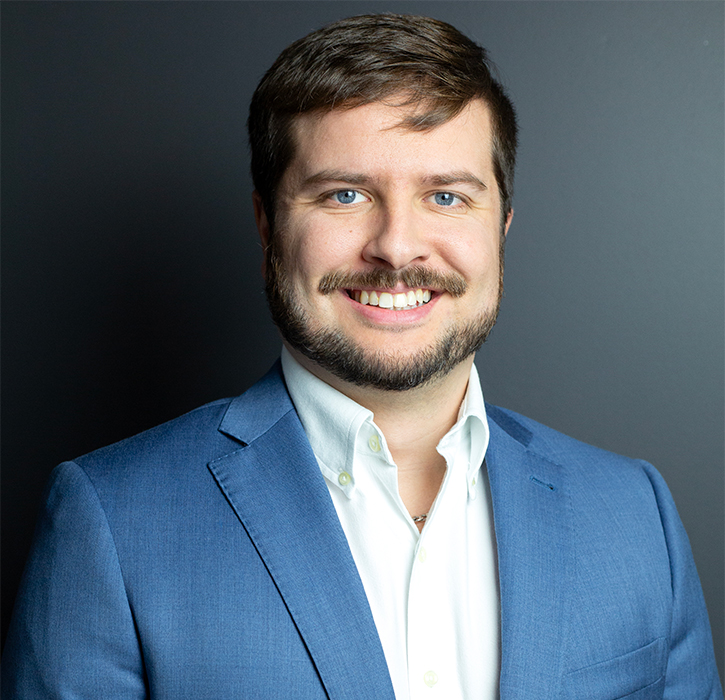
Laura Esquivel, the health and wellness director of the Blocker Norfolk Family YMCA branch, said the program was championed by Price Dodson, who was diagnosed with Parkinson’s in 2014. His experience helped demonstrate both the physical benefits of this exercise and value of having a community who understands what you’re going through.
“For us, Rock Steady Boxing fits into the YMCA’s broader work around chronic disease management and healthy aging,” said Esquivel. “Parkinson’s can progressively affect movement, balance, coordination, confidence and independence, and a traditional group exercise class isn’t necessarily designed around those challenges.”
Esquivel added there’s a larger opportunity for recreation providers with the program. As the populations the Y serves get older and more people are living with chronic conditions, there’s a need for centers to think about how programs can respond to their needs. Programs like Rock Steady Boxing give people another way to remain active, maintain their independence and stay connected to their community.
Additional Details
Rock Steady Boxing is designed specifically for people living with Parkinson’s disease and is included with a YMCA membership. Financial assistance is available, so cost isn’t a barrier to participation.
Participants complete an initial evaluation before they begin, which helps the Y’s instructors understand their abilities and determine where modifications may be needed.
“Classes combine non-contact boxing with functional fitness exercises focused on strength, cardiovascular fitness, balance, flexibility, coordination and overall movement,” said Esquivel. “Participants also work on footwork, hand-eye coordination, manual dexterity and voice exercises.”
Parkinson’s affects everyone differently, so Esquivel said adaptability is a big part of the program. Instructors can modify movements based on each participant’s needs while still keeping everyone engaged in the class.
“There’s also an important social component,” added Esquivel. “Participants are exercising alongside people who understand many of the same challenges they’re experiencing. Over time, that’s created a really supportive community within the program.”
Thus far, response has been extremely positive, as participants have described the program as a lifeline and a place where they feel understood.
Esquivel said this isn’t a high-volume group exercise class, and the Y doesn’t evaluate its success that way.
“It serves a relatively small, but deeply committed group,” said Esquivel. “Consistency and retention are important measures for us. Participants come back regularly, and they’ve developed strong relationships with their instructors and with one another. When you’re looking at a specialized program like this, those measures can tell you as much about its value as the number of people in the room.”
The Future and Industry Advice
One of our biggest considerations moving forward for the Y is building a sustainable instructor pipeline. Esquivel said they’d like to introduce the program to more people living with Parkinson’s and expand its reach as staffing, resources and demand allow.
“That could eventually mean additional locations, class times or levels based on what participants need,” said Esquivel said. “We’d also like to continue strengthening relationships with neurologists, physical therapists, health systems and local Parkinson’s organizations. Those relationships can help connect people with the program who may benefit from it but might not otherwise think of their YMCA as a resource.”
For rec center teams considering starting a Rock Steady Boxing program, it’s important to start with the right people. Instructors who are passionate about working with this population and are willing to know their participants are critical to have.
Esquivel added the certification is expensive, so centers should go into it understanding that there’s a real investment involved.
“You’ll also want to think beyond the certification itself,” said Esquivel. “Consider equipment, space, staff time, scheduling, continuing education and participant recruitment. Don’t assume success has to mean a packed class. Start at a manageable size, listen to your participants and look at attendance and retention alongside things like consistency, confidence, functional progress and social connection. For this program, a committed group that keeps showing up can be a meaningful measure of success.”