

Industry professionals share their thoughts on competing in the fitness landscape and how centers can differentiate from for-profit gyms and offerings.
In an era where for-profit gyms and boutique fitness studios are expanding rapidly, nonprofit community rec centers must leverage their unique strengths to remain competitive and relevant. In the latest Community Voices roundtable hosted by Community Rec, leaders from across the industry explored real-world success stories highlighting innovative programs that have transformed member engagement, while also confronting the common barriers nonprofit centers face — from budget constraints to staffing challenges — and the practical solutions that can overcome them.
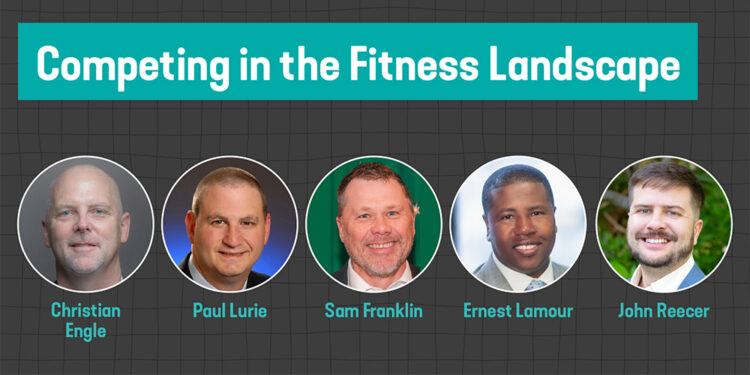
The panel included:
- Christian Engle, the president & CEO of the YMCA of the Suncoast
- Paul Lurie, the CEO of JCC of Greater Baltimore
- Sam Franklin, the president and CEO of the YMCA of Greenville
- Ernest Lamour, the president and CEO of the YMCA of Greater Rochester
Assessing the Competition
Engle said his area is exploding with competition with Florida experiencing a population boom. In fact, he said the fitness landscape in his community is heavily saturated with both boutique offerings and large chain entities as well.
In Baltimore, Lurie said they are seeing an increase of boutique spaces, and companies trying to get into the specific areas of fitness. “We’re seeing people who I think want to get into the community engagement space and using fitness as a vehicle to do that as one of many offerings, whether it’s in the sports leagues and combining fitness with it,” said Lurie.
Lamour said his community is seeing more for-profit gyms struggle to make a large footprint as compared to already established offerings. Meanwhile, Franklin said with Greenville one of the fastest growing cities in the U.S., competition is always increasing.
“Specialized sports personal training facilities have really captured a market here around high school kids and young adults who are specializing in soccer, baseball, golf, etc.” said Franklin. “I think the challenge is just making sure consumers understand the unique value we bring to the table compared to what others are doing with the specialized piece.”
Successful Strategies
Lurie said community rec centers have a unique value proposition that’s very different than a lot of other options. Therefore, competition can be addressed by showcasing who your organization is every day. Many centers are values-based organizations, and he believes many people look for values-based organizations.
Lamour stressed there will always be competition in the industry, and rec centers need to embrace it.
“You’ve got to look for ways to improve your facilities, keep up with the modernization of facilities, stay up to date with equipment, and see what else we can offer to make sure that the member experience is always better,” said Lamour. “One thing that we’re always looking at is what does our net promoter scores look like? You always got to look to innovate right in this space. We have a great opportunity, because we serve people from all stages of life. I think we’re showing up in those spaces a lot better in my opinion than the for-profit entities.”
One mistake Engle believes the industry is making is centers aren’t secret-shopping competition enough to learn what they’re doing successfully. Also, he believes centers need to understand the competition piece from a staffing perspective and that pay is competitive with other job openings.
The YMCA of Greenville tries to focus on the program experience, because Franklin said if members have a bad experience, they’re not going to join the Y. So if programs are scoring low and centers aren’t making changes, then those organizations are just spinning their wheels.
Industry Advantages
Despite rising competition, Engles said nonprofit centers can standout due to the mission work they do and our impacts on their communities.
“The McKinsey group did a big study on YMCAs, and found our pricing is fine, and we don’t have any problems with your pricing,” said Engle. “The real issue was, we weren’t talking enough about our mission and the work that we do in our communities. If we’re strictly trying to market treadmills and strength equipment, then yeah — it’s going to become a price decision at that point for potential members. But if we’re really trying to market ourselves with everything we bring to the table, I think people can connect with that and see more value.”
Lamour said Ys talk about being more than that gym and swim in all the things they do, but they don’t touch on that enough. He stressed the need to talk a lot more about how their mantra is not to turn anyone away from an inability to pay.
Lurie said the industry can have a long-term impact with families that’s deep and meaningful to people beyond just the treadmill or the group fitness class. With being a JCC he said they lean into that value and they’re very upfront with being based on Jewish values, and how they want to be the most welcoming and inclusive place to everyone in the community.
At the YMCA of Greenville, a continued focused in on community partnerships that for-profit gyms can’t create, which is a special perk of nonprofit centers.
Getting the Message Out
“We try to market ourselves with our mission first, and what the community impact is like,” said Franklin. “This is how many people we’re serving in a very positive way, and we try to show all the programs and ages we serve. Also, that everyone is welcome to come in the Y and how financial assistance play a role in that as well.”
Lurie said marketing can be hard as the JCC is a multidisciplinary organization, and sometimes they can get in their own way in terms of trying to market specific things versus the whole of who the JCC. However, he believes they are more successful when they led with the mission and when they are storytelling instead of pure marketing.
Similarly, the YMCA of Greater Rochester highlights and showcases the people who are being served. Lamour said in 2026, they want to tell 300 stories of individuals and families they are serving. They can talk about how they are being served at the Y, so the community can see that impact.
For Engle, he said he doesn’t ever want to see anybody promoting an upcoming program or a membership price, because the social media team should already be involved and engaged in getting their communication in some other form or fashion. Instead, they should really be sharing stories from YMCA experiences.
What Not to Do When Competing
Lamour called into question why some rec centers are adopting 24-hour fitness spaces, as that’s too closely mirroring what for-profit offerings do and it could call into question nonprofit status.
At the YMCA of the Suncoast, Engle warned against putting too much focus into discounting rates. “The moment we start devaluing what we offer, I think that’s when everybody else is going to begin to devalue us as well,” said Engle. “I think the mistake a lot of us go down is when we start worrying about if I discount this, I’ll get 200 people to join, versus if I just left things alone and I get 100 people to join, I’m better off than I was without the discount. Discounting should always be the fifth or sixth thing you’re talking about, not the first thing you’re talking about.”
Franklin agreed and said rec centers don’t solely need to compete on price. Instead, centers should focus on what’s best for those organizations while also training and investing in staff.
Then, Lurie advised while it’s important to be risk aware, leaders shouldn’t be risk averse. He urged the need to take risks and to innovative, as the industry must think about the rec centers of tomorrow to not fall behind other entities.
Engles added that some centers are so caught up in protecting their legacy that they’re forgetting about the future. More leaders should be focused on updating their facilities despite their historical relevance
Lasting Advice
Franklin’s last tip for leaders was to constantly keep an eye on data and metrics and be willing to have courageous conversations with your board and staff.
“We got to step in and have some of those conversations sometimes, and you got to invest in your people and build that positive culture we want and again,” said Franklin. “Also, bring in a third party. It’s never bad to bring in an outside entity and get their input. Finally, be confident in who we are, and tell our story. Don’t try to out compete everybody, because this is who we are, and we’re going to be here. Let’s continue to beat that drum.”
Lurie recommend being honest with yourself about where things are and what’s going on, and not beat around the bush. Also — trust your gut, which is an important metric of where you’re feeling about things and data and people. It needs to be supported by facts, and it needs to be led the right way forward. But trust your gut when you’re making decisions.
Finally, Engle advised leaders that understand that their data is paramount and to truly understand what’s going on at their locations. “The biggest lesson is to sit down and register for a class and see what that process like,” said Engle. “If I’m going to do anything online, and it takes me more than like four or five steps — I’m done. How do you simplify all that? Make sure you know what’s going on, what the processes are like and what systems are like, so you aren’t just thinking this is what everybody goes through.”
Watch the full on-demand conversation below after registering for free!