

For program directors and executives at nonprofit community rec centers across the country, the challenge rarely has anything to do with the quality of the work. Programs are effective, the staff are committed and members are showing up. The challenge is everything that happens in between — the spreadsheets, the compliance tracking, the grant reports, the manual data pulls that eat up hours and were never meant to be spent that way.
Arly — a platform purpose-built for youth-serving organizations — was founded to solve exactly that problem. And the person leading the way for Arly brings something most software companies don’t have: a career spent inside these programs before building technology for them.
When the Tools Don’t Fit
Lauren Gilbert, the CEO of Arly, didn’t come to youth programming through technology. She came through teaching, administration and years of building programs at the ground level. That experience gave her a clear view of what was going wrong and why.
“The clearest signal was how directors spent their time,” said Gilbert. “People who chose this work because they believed in what it does for kids were spending their afternoons reconciling attendance in spreadsheets, chasing down staff certifications, and manually pulling together reports for funders who needed the data by Friday.”
The problem she found wasn’t poor organization or lack of effort. It was infrastructure. The software available to directors had been built for other industries or was so complex to configure that a tech team was required just to set it up. Neither option served the people running the programs.
The consequences were real and measurable. Directors with the talent to lead transformative programs were burning out and leaving. Organizations were losing funding not because their offerings weren’t working, but because they couldn’t demonstrate results quickly or credibly enough. Each time a long-tenured staff member walked out the door, the institutional knowledge they’d built over years left with them.
“That’s not a people problem,” said Gilbert. “That’s an infrastructure problem.”
35 Years of Evidence
What sets Arly apart from other platforms isn’t that it serves youth-serving organizations — it was built by people who spent decades inside them. The platform is rooted in more than 35 years of research, evidence and operational experience running youth programs at scale.
For an executive director evaluating platforms, it means walking into a system that already understands the funding models, compliance pressures, staffing realities and reporting requirements that define this work. There’s no months-long configuration phase and no translating your operations into a general-purpose framework that wasn’t designed with you in mind.
“When you open Arly, it already speaks your language,” explained Gilbert. “It’s structured around how your programs actually run, not how a general-purpose system thinks they should run. You’re not spending months configuring it to fit. It fits because it was built to.”
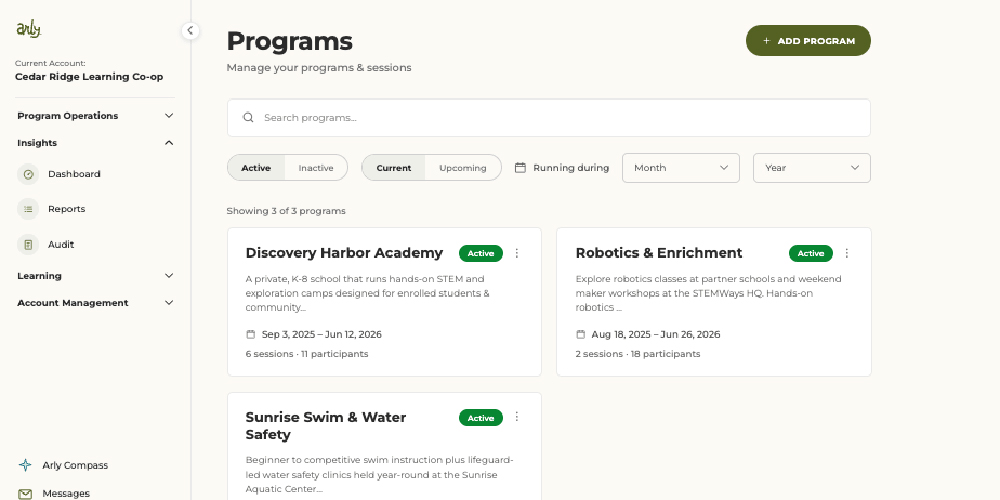
For organizations managing multi-site complexity — multiple branches, lean admin teams and boards asking for outcome data now — that starting point matters enormously. Enrollment, attendance, staff coverage and program activity across every site are visible in a single place. Accountability is built into daily operations rather than layered on top, so when it’s time to report to your board, the data is already there.
The staffing dimension may be where Arly has made its most meaningful contribution. Turnover in youth programming is a persistent challenge — not a temporary one. When someone who ran a summer program for years leaves, what they knew goes with them. Arly is designed to hold that knowledge inside the platform so programs don’t restart from scratch each time a staff member moves on.

AI That’s Built-In
In an era when virtually every software platform has attached an AI feature to its marketing, Arly’s approach to artificial intelligence stands apart both philosophically and technically.
Arly Compass is the platform’s integrated AI layer, and Gilbert is direct about what it isn’t. “It’s not a chatbot you open in a separate window,” she said. “It’s not a search tool, and it’s not a general-purpose AI that’s been given a youth programming persona.”
What Compass actually is: a knowledgeable presence embedded in the platform that already knows how your program runs. It knows enrollment numbers, schedules, staffing patterns and compliance requirements. When a staff member has a question about a family’s attendance history or a participant’s program status, Compass surfaces that information in context, meeting every team member where they are regardless of their role or their comfort with technology.
The distinction Gilbert draws reflects a deeper design philosophy. Compass was developed from the beginning as part of Arly, drawing on more than three decades of youth programming knowledge. It understands the vocabulary, the compliance context, and the operational rhythms specific to YMCAs, JCCs, afterschool programs, summer camps and recreation departments.
That philosophy has been recognized externally. Arly received the EdTech Breakthrough AI Innovation Award this year — the fourth consecutive year the company has been honored by that program.
“I’m proud of it,” said Gilbert, “But what I’m prouder of is what it represents — a fundamentally different philosophy about where AI belongs in this work: built in and not bolted on.”
A Story of Sustainable Growth
The experience YMCA of the Triangle— located in North Carolina — has had with Arly offers a concrete look at what the platform makes possible for organizations already doing strong work.
The Y runs Power Scholars Academy, a summer learning model developed in partnership between Y-USA and Arly. The collaboration produced meaningful outcomes like scholars making measurable academic gains, credible evidence for its board and funding partners, and a model that leadership could stand behind.
The results enabled growth. YMCA of the Triangle expanded from two sites to five. Enrollment climbed from roughly 100 scholars to nearly 600. That growth held because the organization could demonstrate outcomes with credibility — not because of favorable circumstances, but because the infrastructure supported the evidence.
“Their leadership built those programs,” said Gilbert. “Their staff delivered them. The partnership made the outcomes case. But the right infrastructure means they don’t have to rely on a partner organization to surface their own data. It’s there every day without someone having to go find it.”
What Arly made possible for YMCA of the Triangle is now built directly into the platform: cross-site visibility, attendance tracking and outcomes-based reporting that once required dedicated external support are now standard features. For organizations doing the work and seeing the results, Arly provides the infrastructure to scale without adding operational weight.
The Real Cost of the Status Quo
For executive directors weighing a platform transition, Gilbert said she understands the hesitation. The responsibility is real — programs, staff, participants and funders. There’s no room for a change that goes sideways.
But she challenges industry leaders to account fully for what staying put costs.
“Most organizations in this space are paying for three, four, sometimes five different tools that don’t talk to each other and are still filling the gaps manually,” said Gilbert. “Every week your team spends managing details and data across disconnected systems is a week they’re not spending on program quality. Every time institutional knowledge walks out the door with a departing staff member, you absorb that loss. And every grant report that takes two weeks to pull together instead of two hours is two weeks of someone’s capacity.”
Arly’s answer is one system — a single source of truth the whole team works from — one that your board and stakeholders can both rely on. As the platform continues to grow, that system is expanding beyond program management to encompass the full scope of organizational operations, including member management, facility operations and beyond.
“The status quo has a cost,” said Gilbert. “It just doesn’t show up on a line item.”