

With community expectations growing and budgets tightening, industry leaders are rethinking how pools are designed, equipped, staffed and used, making it difficult to know where to invest first.
However, Cihan Ozdemir, the vice president of sales at DynaDome, said the most successful communities aren’t starting with the question of what type of building to construct. Instead, they’re starting with what they need the facility to accomplish.
“An aquatics facility should be viewed as a long-term community resource rather than simply a pool and a building,” said Ozdemir. “Its value is determined by how consistently it can serve residents, support programming and respond to changing needs.”
That sentiment is consistent through the trends, challenges and solutions found below from leaders across the industry from DynaDome, Paddock Pool Equipment Company, JCC of Greater Columbus and the YMCA of Southeastern North Carolina.
One of the most significant trends Ozdemir is seeing is the demand to extend outdoor aquatics programming beyond the traditional summer season.
“Communities want to offer swim lessons, competitive swimming, water safety programs, therapy, fitness and general recreation across more of the year,” said Ozdemir. “We’re also seeing greater interest in flexible facilities. Operators don’t necessarily want to choose between an outdoor pool and a permanently enclosed natatorium. They want the benefits of an outdoor environment during favorable weather while still having the ability to protect programs from unfavorable conditions.”
Also, Ozdemir said many communities are prioritizing improvements to existing facilities instead of starting over. Enclosing or adapting an existing outdoor pool can preserve a valuable community asset while avoiding some of the cost, time and disruption of building an entirely new indoor facility.
Learn more and request a free quote at dynadome.com.
Mark Hines, the VP of sales and marketing at Paddock Pool Equipment Company, said owners and operators are currently looking beyond the initial purchase price and asking what equipment will cost to operate, maintain and eventually replace over the next 20 to 50 years.
Indoor air quality is another growing focus. Hines said chloramines and their impact on swimmers, staff, spectators and the facility itself are becoming part of design conversations much earlier in the process.
“At Paddock, more than a century in the commercial aquatics industry has given us the opportunity to see what happens to pools not just when they open, but decades later,” said Hines. “Some of the most successful facilities are those where owners made decisions with longevity in mind from the beginning.”
Mark Eldridge, the aquatics director at the Columbus JCC, said the J’s recently opened Sam Baker Aquatics Center was designed around one of the industry’s most pressing concerns: lifeguard staffing.
“Irregular pool shapes and large amenities can create blind spots, and every blind spot can mean another lifeguard station,” said Eldridge. “We designed our pool very intentionally with that in mind. The layout keeps families close together and maximizes lifeguard sightlines, so we don’t need redundant guard stations to cover areas hidden by the pool’s shape or by play features. The result is a space that’s safer, easier to staff and better for families.”
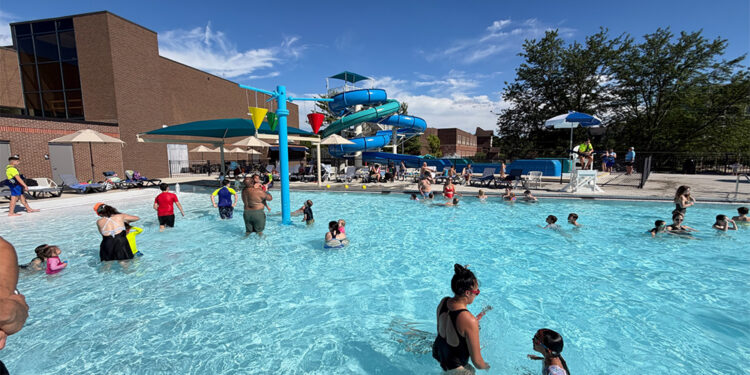
The new center features 206,000 gallons of water across connected leisure and lap pools. The leisure pool includes zero-depth entry with an ADA accessible ramp, a shaded area with water geysers for children, lemon drops, dump buckets and a basketball hoop. The center also has a six-lane, competition-ready lap pool, two 18-foot waterslides, and a multi-use wet classroom that hosts birthday parties, certification classes and community gatherings.
Eldridge said the biggest hits have been the leisure pool and the slides, as the leisure pool lets families with kids of different ages enjoy the space together instead of being spread out between a baby pool and a main pool, while the waterslides are the most exciting addition.
Annie Gibbs, the communications specialist at the YMCA of Southeastern North Carolina, said her Y is taking a different approach to meeting demand by building bigger.
Thanks to support from Oaz Nir, the New Hanover Community Endowment, the Waves of Wilmington swim team and other partners, the Y is constructing an $18 million, 50-meter indoor aquatics center at the Nir Family YMCA campus in Wilmington, North Carolina.
The expansion adds a third indoor pool to the campus. The competition-style pool will feature ten 50-meter lanes and a movable bulkhead, supporting both long-course and short-course seasons as well as instructional and community programs.
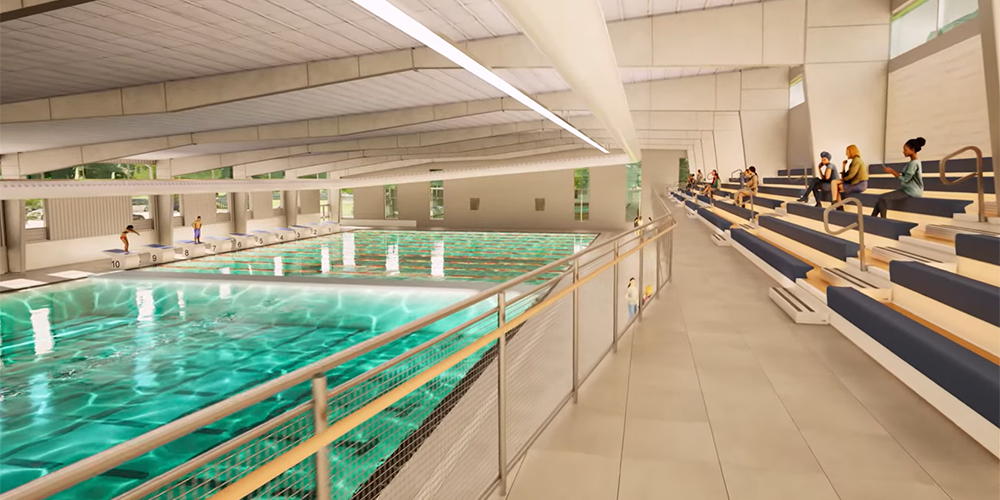
The project also includes a dedicated entrance and lobby, a spectator mezzanine seating more than 500, team and event spaces with locker rooms, concessions and a multipurpose room, and around 120 additional parking spaces.
“As one of the region’s most heavily utilized aquatics facilities, this expansion builds the infrastructure needed to meet growing community demands for aquatic programming,” said Gibbs.
She pointed to several trends driving the project: rising participation in youth and high school swimming, demand for water exercise and therapy for every age group, and a boom in endurance sports. The YMCA Wrightsville Beach Sprint Triathlon sold out for the second consecutive year, which Gibbs said has increased demand for year-round, deep-water lap swimming.
Water safety is another priority. Through the Schools in Pools initiative — a coalition with New Hanover County Schools, the New Hanover Community Endowment, the YWCA of Lower Cape Fear and NSEA Swim — the Y serves nearly 2,000 second-grade students annually. The new space provides the scalable infrastructure to reach youth countywide, alongside lifeguard training and certification programs.
“The primary challenge is matching the facility’s footprint with steady community growth,” said Gibbs. “High demand limits water fitness class sizes, lap lanes are hard to come by, and local high school and youth teams are often pushed into late-night practice windows. Activity-specific water temperatures add another wrinkle, since swim lessons and low-impact programs thrive in warmer water while competitive swimmers need cooler water. A multi-pool campus allows the Y to customize temperatures across zones at the same time.”
Industry Challenges
Despite these promising strategies, hurdles still exist for rec centers. Ozdemir said the largest challenge is balancing community demand with financial reality. Operators are being asked to provide more programs and longer seasons while managing limited capital budgets and rising operating expenses.
“Weather and seasonality also create significant challenges,” said Ozdemir. “Outdoor facilities may sit unused for much of the year, while rain, storms, extreme heat or unexpected temperature changes can cause cancellations even during the normal operating season. Those interruptions affect participants, staffing, program continuity, and revenue.”
Traditional indoor natatoriums come with their own burdens, as heating, cooling, ventilation and humidity control create substantial long-term operating obligations. Existing sites bring limits too, from available space and aging infrastructure to permitting and the need to keep parts of a facility open during construction.
To overcome these issues, Ozdemir said to evaluate alternatives based on total lifecycle value. He also recommended considering adaptable solutions. A retractable structure can let an existing or new pool operate enclosed in unfavorable weather and open up when conditions permit, providing extended-season programming without giving up the qualities that make outdoor aquatics appealing.
For Hines, the biggest challenges he’s seeing are limited budgets and aging infrastructure. Choosing the least expensive solution today can create significantly higher maintenance, replacement and operating costs later, and many community pools have served their communities for decades.
He offered four principles for navigating those decisions:
1. Look beyond the initial equipment cost.
Ask how long equipment is expected to last, what routine maintenance it requires, how much water and energy it consumes and how easily it can be serviced.
2. Think of the pool as one interconnected system.
Filtration, circulation, gutters, air quality, drainage and deck equipment all impact performance. Decisions in one area can have consequences elsewhere.
3. Address chloramines at their source.
For indoor facilities, incorporating source-capture strategies into the pool design is more effective than relying solely on the HVAC system to manage the symptoms. It also helps protect the building and equipment from corrosion.
4. Involve experienced professionals early.
The best solutions often come from considering long-term operation during design or renovation, not after problems appear.
Final Thoughts
Eldridge’s advice to other facilities is to build safety through staff. “You cannot have a safe facility without properly trained and engaged staff supervising the pool,” he said. “Without a sense of safety, the community won’t trust your facility.”
JCC of Greater Columbus has navigated the lifeguard shortage by engaging new staff from the very beginning, starting with skills evaluations during the interview process, followed by thorough onboarding, shadowing and in-service requirements before a new guard ever takes the stand.
Pay matters as well. Eldridge said recreation and aquatics wages have historically been low, and pay equity is key to staff satisfaction and longevity.
“Do a wage analysis of other entry level jobs your same staff demographic might apply for, not just other aquatics positions,” said Eldridge. “If those jobs pay more with less responsibility than a lifeguard carries, it’s time to rethink your wage structure.”
Gibbs added a pool can be more than a place to swim. While the new competition center will draw athletes and spectators from across the region, she said a large part of the impact will be felt by community members who use the facilities regularly.
Ozdemir advised that communities should avoid assuming there are only two choices: maintain a seasonal outdoor pool or construct a conventional indoor natatorium. Flexibility has lasting value, and a facility that can respond to weather, seasons, and evolving programs is better positioned to increase participation and reduce cancellations.
Finally, Hines closed with a reminder that a pool doesn’t have to be new to benefit from better technology. Filtration, indoor air quality and other systems can often be upgraded as part of a renovation strategy.
“Ultimately, the goal shouldn’t simply be to build or operate a pool for today,” said Hines. “It should be to create an aquatics facility that can continue serving its community reliably, efficiently and safely for generations.”